
Panorama 1
Trisomies 21, 18 and 13; triploidy; sex chromosome trisomies; monosomy X.
Panorama— a highly accurate non-invasive prenatal fetal DNA screening test (without entering the abdominal cavity) that can provide important information about your baby's health from nine weeks of pregnancy. Panorama can identify risks with 99.9% reliability.
Introduction
In the first quarter of 2013, Natera Inc. began offering Panorama™, its non-invasive prenatal screening test for fetal aneuploidies, to detect trisomy 21 (Down syndrome), trisomy 18 (Edwards syndrome), trisomy 13 (Patau syndrome), monosomy X (Turner syndrome) and, on request, fetal sex.¹˒² The test analyses cell-free maternal and fetal DNA (cfDNA) from maternal plasma and can be performed from nine weeks of pregnancy. It uses molecular biology and bioinformatics approaches that have significant advantages over traditional non-invasive screening and other cfDNA-based methods, with outstanding accuracy and specificity.
Traditional screening methods
Trisomies 21, 18 and 13 are the three most common aneuploidies. Together they occur in approximately one in 450 live births, and trisomy 21 is the most common of the three.³˒⁴ Earlier first-line screening used serial measurements of biochemical markers in maternal serum in the first and second trimesters, combined with first-trimester ultrasound measurement of nuchal translucency (NT). Designed to detect trisomy 21, this integrated approach also detected trisomies 13 and 18; increased NT, cystic hygroma and other ultrasound indicators are associated with certain sex-chromosome aneuploidies. However, large studies found trisomy 21 detection rates of only 79–90%, with a 5% false-positive rate.⁵ Positive screening results require confirmation by an invasive procedure such as chorionic villus sampling or amniocentesis. The risk of pregnancy loss associated with this procedure is reported as up to one in 300.⁶ Because of limited detection, some affected pregnancies go unidentified before birth. These methods were also not specifically designed to identify sex-chromosome aneuploidies and therefore do not detect them reliably.
Cell-free fetal DNA in maternal blood
The discovery of fetal cell-free DNA (cfDNA) circulating in maternal plasma enabled a new approach to fetal aneuploidy screening: non-invasive prenatal testing (NIPT). Because fetal cfDNA crosses the placental barrier into maternal blood, a simple maternal blood sample can reveal an extra fetal chromosome without the risks of invasive procedures. Fetal cfDNA is present at a substantial concentration, averaging about 10% of total cell-free DNA.⁷ This 'fetal fraction' correlates positively with gestational age and, according to preliminary evidence, negatively with maternal weight. Accurate assessment of fetal chromosome copy number using cfDNA isolated from maternal plasma requires amplification and further bioinformatics analysis. There are two main bioinformatics approaches: a first-generation quantitative or 'counting' method used by most cfDNA tests, and a second-generation approach incorporating genotypic information, used by Natera.
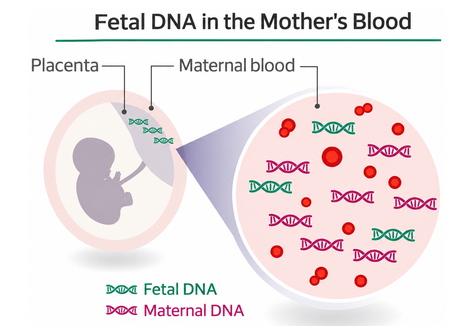
Cell-free DNA approaches for assessing fetal chromosome copy number
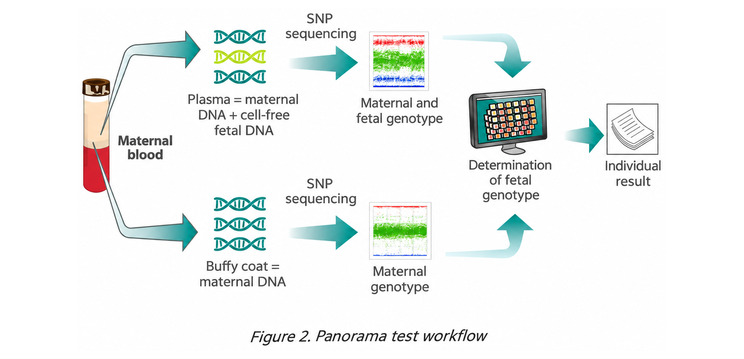
Natera's Panorama specifically amplifies and sequences single-nucleotide polymorphisms (SNPs), thus distinguishing maternal and fetal genotypes. Panorama uses a proprietary algorithm called Next-generation Aneuploidy Test Using SNPs (NATUS). Maternal blood leukocytes are used to isolate and identify maternal DNA, which is then used to exclude the maternal genotype, yielding a more robust fetal genotype and greater accuracy even at a fetal fraction of 4% (Figure 2). Because no reference chromosome is required, the approach can detect triploidy, estimated in the source at approximately one in 1,500 pregnancies at 10–14 weeks.⁸ Its bioinformatics approach also enables more quality control. Validation studies cited in the source reported accuracy above 99% and specificity above 99% for autosomal trisomies and fetal sex, as well as sensitivity of 91.7% and specificity above 99% for monosomy X (Turner syndrome).² The source reports that Panorama always assigns high or low risk for monosomy X, which it describes as more common in the second trimester than all autosomal trisomies combined.⁹ About 5% of samples initially did not meet Natera's stringent measurement standards; most required another blood draw. Preliminary clinical data in the article indicated that more than 90% of repeat samples then passed quality control, yielding an overall no-result rate below 1%.¹⁰
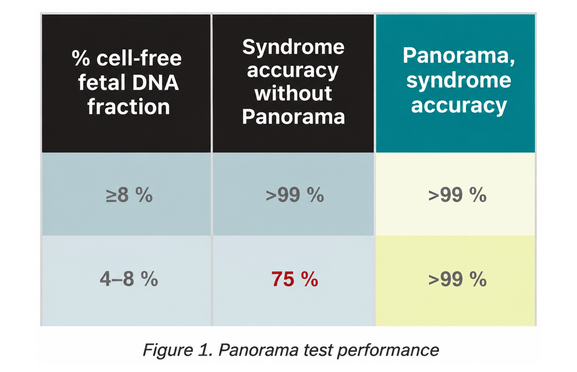
Panorama is not the only non-invasive prenatal test available on the market. First-generation NIPT technologies use only quantitative 'counting' to assess fetal chromosome copy number and do not distinguish maternal from fetal genotypes in cfDNA. They compare the relative number of sequence reads from the chromosome of interest, such as chromosome 21 (whose trisomy causes Down syndrome), with a control chromosome assumed to be euploid. Although more effective than biochemical screening and ultrasound for detecting trisomy 21, this approach performs less well for trisomy 18, trisomy 13 and sex-chromosome aneuploidies.¹¹˒¹³˒¹⁴ Accuracy also decreases at low fetal fractions. Below 8% fetal fraction, the reported detection rate was only 75% for counting-based tests (Table 1).¹² Studies cited in the source found that approximately one quarter of women at 9–14 weeks of pregnancy have fetal cfDNA fractions of 4–8%.⁷ It also cites trisomy 13 detection accuracy of only 80–91.7%, and notes that monosomy X was commonly reported only when detected. These tests had false-positive rates ranging from 0.1% to 1.1%, reducing the positive predictive value.¹¹–¹⁴ Panorama did not have these limitations.
Use of the Panorama test
The Panorama test can be ordered from the ninth week of pregnancy — earlier than any other test. It consists of a maternal blood sample and a buccal swab from the father. The father's sample may be useful in 1–2% of cases to reduce the risk of errors, but it is not required, because it does not affect the accuracy of the results. Special blood-collection tubes that preserve cell-free DNA are used for sample collection; the samples are shipped at room temperature to Natera's CLIA-certified laboratory in San Carlos, California. After the samples are processed, a report is generated containing an individual risk assessment for each chromosome investigated. Fetal sex is reported on request. Patients with a high-risk result for fetal chromosomal abnormalities are advised to undergo further testing. Genetic counselling is recommended for all patients.
Conclusions
Panorama offers the highest overall performance for detecting trisomy 21, trisomy 18, trisomy 13, monosomy X and fetal sex. Its low false-positive rate can reduce unnecessary invasive diagnostic procedures compared with biochemical screening and ultrasound while providing earlier information. Likewise, a low false-negative rate means more affected pregnancies can be identified early, giving parents and clinicians more time to prepare. The rapid introduction of cfDNA-based testing represented a paradigm shift in prenatal screening. The original text notes that professional bodies such as the American College of Obstetricians and Gynecologists and the International Society for Prenatal Diagnosis had recommended cfDNA-based non-invasive screening for fetal aneuploidies in women at increased risk. Because Panorama analyses SNPs, the source also describes it as suitable for detecting subchromosomal copy-number changes, such as deletions, thereby expanding the scope and value of clinical testing.
Have a question?
Let us discuss it. Complete the form and our specialist will answer your questions.
We serve patients across Georgia!
Three Panorama screening panels are available. Panel selection depends on pregnancy characteristics.
Trisomies 21, 18 and 13; triploidy; sex chromosome trisomies; monosomy X.
All conditions in Panorama 1, plus 22q11.2 deletion syndrome (DiGeorge syndrome).
All conditions listed above, plus an expanded microdeletion panel: 1p36, Angelman syndrome, Cri-du-chat syndrome and Prader–Willi syndrome.
Fetal sex and Rh factor identification are included with each panel; fetal Rh is assessed for Rh-negative mothers.
Panel availability varies for twins, IVF, donor eggs and surrogate pregnancies. Please consult a specialist when selecting a panel.